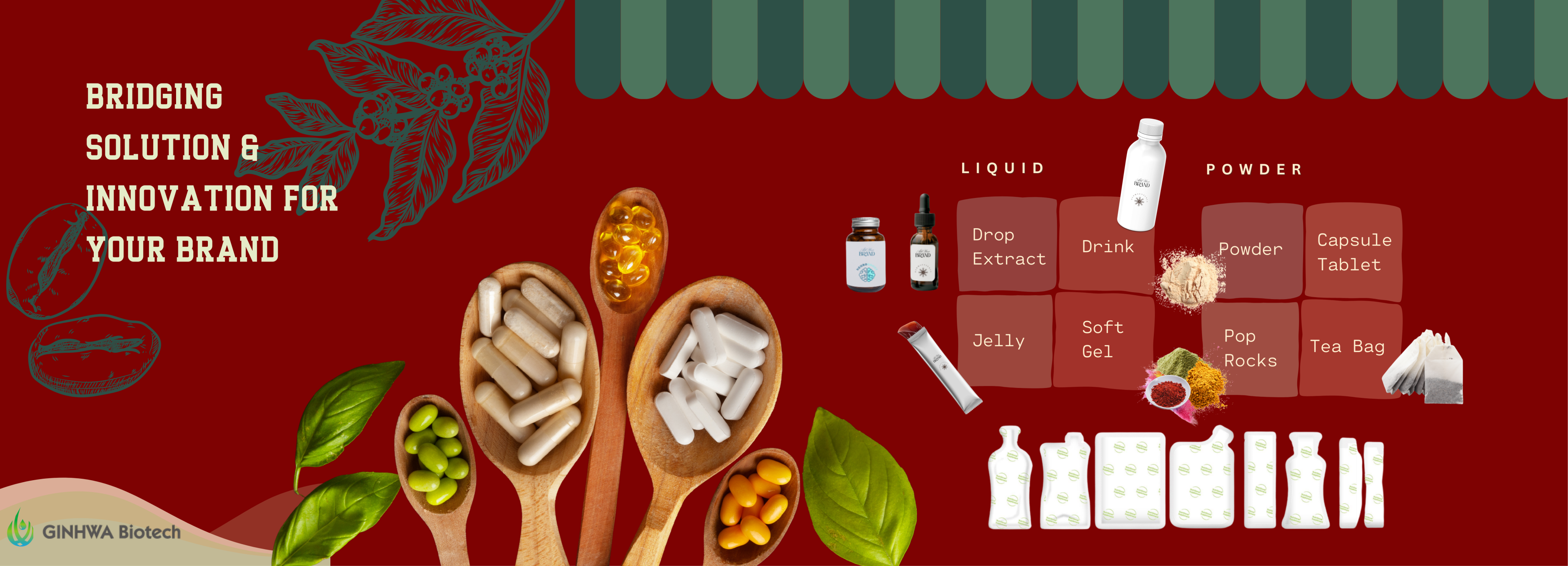
What products are suitable for the Tablet format?
The Tablet format is suitable for developing multivitamins, mineral supplements, herbal health tablets, functional formula tablets, probiotic compressed tablets, and dietary supplement tablets. Tablets offer advantages such as precise dosing, long-term storage stability, consistent appearance, and easy portability. Tablet weight, hardness, disintegration time, and shape can be adjusted based on requirements, making them ideal for channel brands, dietary supplement brands, and large-scale production product lines.
The Tablet format supports single-ingredient, multi-ingredient, multi-layer tablets, and coated tablets, enabling the development of more precise and differentiated nutritional supplement formulations.
Tablet types and packaging specifications
Gin Hwa offers a variety of tablet shapes and weight specifications. The most suitable format can be selected based on product design, swallowing comfort, and formulation density:
- Rounded tablet: approx. 700mg: Suitable for high-dosage or multi-ingredient formulations.
- Round tablet: approx. 600mg: Suitable for general health supplements and basic nutrition tablets.
- Oval tablet: approx. 500mg: Suitable for easy-to-swallow formulas, as well as children’s or women’s health products.
Tablets can be paired with various packaging options such as bottles, aluminum blister packs (Alu-Alu / PVC), aluminum pouches, and canisters. Minimum order quantities and packaging customization vary depending on formulation complexity and appearance design.
Ingredients and formulation conditions for the Tablet format
The Tablet format is well-suited for formulations that require precise dosing, controlled release, and long-term storage stability. It supports the following ingredient types:
- Vitamin and mineral powders: Core components for basic supplementation and comprehensive formulations.
- Amino acids and peptide powders: Used in sports nutrition, recovery, and functional formulas.
- Herbal extracts and concentrated powders: Suitable for functional health products and compound herbal designs.
- Probiotic tableting technology: Evaluated based on strain pressure resistance and water activity conditions.
- Dietary fiber, grain powders, and functional base powders: Can be combined with various nutrients as formulation bases.
- Multi-layer or multi-phase tablets: Designed with different dissolution rates and staged release mechanisms.
Tablet processing requirements and technical considerations:
- Powders must have sufficient compressibility (flowability and compressibility) to prevent cracking or chipping.
- Water activity must meet tableting requirements to reduce the risk of caking and moisture absorption.
- Disintegration time and hardness can be adjusted based on formulation purpose and target consumer needs.
- Sensitive ingredients can be combined with coating technologies to enhance stability and palatability.
- Tablet shape, thickness, and beveled edges can be adjusted to improve swallowing comfort.
Tablet Manufacturing Process Management & Three-Level Quality Assurance
1)Level One: Tablet Raw Materials & Process Control
Tablet manufacturing requires stable compression performance, controlled hardness, proper disintegration time, and ingredient uniformity. Gin Hwa implements standardized process checkpoints, establishing complete records from raw material intake through tablet packaging and shipment.
Raw Material Identification & Specification Inspection
Verify material origin, specifications, and inspection reports to ensure compliance with tablet development requirements and safety standards.
Powder Flowability, Moisture & Compressibility Testing
Evaluate powder flow properties, water activity, and compressibility to reduce risks of capping, sticking, and unstable compression.
Blend Uniformity & Particle Size Adjustment
Through blending and particle size optimization, ensure even distribution of key ingredients and maintain good tableting performance.
Compression Parameter Setup & Weight Control
Set compression force, thickness, and target weight according to formulation, with in-process monitoring to maintain batch consistency.
Disintegration Testing & Appearance Inspection
Measure disintegration time and inspect tablet surface integrity and color to ensure swallowing comfort and functional performance.
Coating Processing (Optional)
Provide enteric coating or film coating as required to improve stability and palatability.
Packaging & Labeling Management
Support blister packs, aluminum pouches, bottles, and other packaging formats with established labeling and batch control systems.
Finished Product Retention & Production Scheduling
Conduct final inspections and retain samples, combined with project-based production scheduling and shipment management to ensure stable channel replenishment.
2)Level Two: International Quality Standards
Gin Hwa’s tablet manufacturing environment fully complies with international food safety standards. From raw material inspection, compression, and coating to final packaging, all processes are under controlled management to meet the quality requirements of domestic, international, and cross-border OEM / ODM brands.
Through multiple certification systems, we reliably support long-term cooperation for standard nutritional tablets, functional formula tablets, and cross-border market products.
3)Level Three: External Audits & Government Inspection
The factory undergoes regular regulatory audits and implements CAPA procedures, batch traceability, and product recall mechanisms to ensure comprehensive food safety protection before tablets enter the market.
Tablet OEM FAQ
Q1|What is the MOQ for Tablet OEM?
MOQ varies based on tablet type, packaging format, packaging customization level, and formulation compressibility. In general, tablet production offers flexibility for small trial batches to validate the market, and can also be scaled up for mass production based on channel requirements.
Q2|Can tablet hardness, disintegration time, and swallowability be customized?
Yes. Swallowability can be optimized by adjusting compression force, thickness, and bevel-edge design. Combined with disintegration formulation and coating parameters, tablets can be developed to fit different age groups and functional positioning.
Q3|What ingredients are suitable for tablets?
Vitamins, minerals, herbal extracts, peptide powders, amino acid powders, and selected probiotics (subject to evaluation of compression tolerance and water activity) can be used in tablet formulations. Final feasibility depends on formulation characteristics and stability requirements.
Q4|How long does the tablet OEM development process take?
A typical process includes “formulation confirmation → blending trials → tablet compression pilot run → coating (if needed) → packaging confirmation → mass production.” The common development timeline is about 6–10 weeks, and the actual schedule may vary depending on formulation complexity and customization requirements.
Q5|Can we proceed with OEM if we already have a formula?
Yes. If you already have a powder formula, we can help evaluate compressibility and moisture content, and adjust compression parameters, disintegration formulation, and coating design to make the existing formula more suitable for tablet production and long-term storage.