
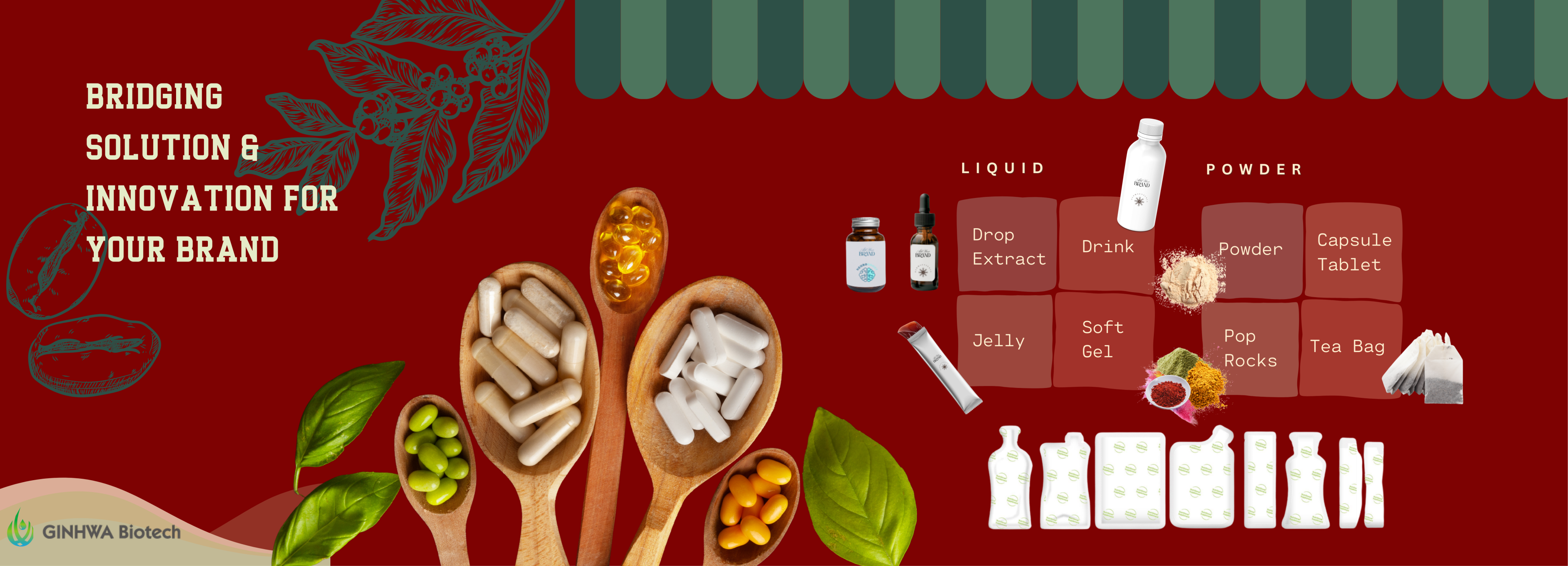

Capsule
| Item | Specification |
|---|---|
| Tablet Specification Range | 300–500mg |
What products are Capsules suitable for?
Capsules are suitable for botanical powders, concentrated powders, multi-ingredient functional blends, vitamins and minerals, probiotic powders, health base powders, postbiotic powders, and other products that require “precise dosing + easy swallowing.” Capsules offer advantages such as effective taste masking, high formulation flexibility, precise dosing, and easy swallowing, making them especially suitable for supplements that need odor control, multi-ingredient stacking, or ingredient protection.
Capsules can support single-ingredient formulas, multi-ingredient blends, and modified-release designs (subject to technical requirements), serving brands from small-batch new product launches to large-scale channel production.
Capsule types and packaging specifications
Gin Hwa offers Capsules in multiple fill-weight designs. The most suitable specification can be selected based on ingredient bulk density, swallowing experience, and formulation needs:
- Capsule fill range: approx. 300–500mg: actual fill weight is adjusted according to ingredient bulk density and formulation design.
Compatible with multiple packaging formats:
- Bottles (HDPE / PET / glass)
- Blister packs (Blister)
- Bulk aluminum bags
- Customized cartons and gift sets
MOQ, packaging film thickness, and colors (such as opaque Capsules or two-tone Capsules) can all be adjusted based on brand positioning and channel requirements.
Ingredients and dosage-form requirements for Capsules
Capsules can encapsulate a wide range of powders or granules and are one of the most versatile dosage forms for dietary supplements:
Applicable ingredients:
- Botanical powders and herbal concentrated powders
- Vitamin and mineral powders
- Probiotic powders (additional evaluation for moisture resistance and filling conditions may apply)
- Peptide powders, protein powders, and small-molecule nutrients
- Functional powders for immunity, metabolism, and beauty/wellness
- Special functional blends (combined Eastern & Western powder-based formulations)
Dosage-form requirements and limitations:
- Powders should have adequate flowability to avoid inconsistent filling or machine blockage.
- Water activity and moisture content must be controlled to prevent Capsules from absorbing moisture and deforming.
- Particle size should be appropriate to avoid clogging filling channels or causing segregation.
- Heat-sensitive ingredients can be filled directly to avoid high-temperature granulation processes.
- Vegetarian Capsules or gelatin Capsules can be selected based on market preferences and channel requirements.
Capsule-specific process management and three-tier quality assurance
1)Tier 1: Capsule raw materials and process control
The Capsule manufacturing process requires control of powder uniformity, moisture content, filling-weight stability, and Capsule integrity. Gin Hwa verifies each standardized checkpoint to ensure consistent quality—from contents to appearance.
Raw material identity verification and specification confirmation
Verify raw material origin, specifications, and inspection documents to ensure they meet Capsule filling requirements and product positioning.
Milling, sieving, and blend-uniformity testing
Adjust particle size through milling and sieving conditions to ensure key ingredients remain evenly and consistently distributed after blending.
Powder flowability, moisture content, and particle-size testing
Test powder flowability and water activity to reduce risks of filling blockage, caking, and moisture absorption.
Capsule filling-weight calibration
Use in-line weighing and sampling inspections to ensure the fill weight of each Capsule consistently falls within specification.
Capsule shell integrity and moisture testing
Check closure tightness, shell integrity, and moisture content to prevent loosening, deformation, or brittleness.
Appearance inspection and color control
Inspect for cracks, powder residue, or color variation to maintain appearance consistency across batches.
Packaging selection, labeling, and batch/lot management
Select packaging structures based on moisture protection needs and channel specifications, and establish labeling and lot traceability systems.
Finished product inspection, retain samples, and stability testing
Complete finished product testing and retain samples, along with stability evaluation and project scheduling and shipment management.
2)Tier 2: International quality assurance standards
Capsule production environments and equipment comply with international food safety standards. From raw material receiving and Capsule filling to packaging and shipment, all steps are managed under a systematic quality framework to support multi-market sales requirements.
Backed by multiple quality and food safety certification systems, Gin Hwa can reliably support long-term OEM/ODM partnerships for general brands, publicly listed companies, and multinational dietary supplement businesses.
3)Tier 3: External audits and government inspections
The facility regularly cooperates with competent authority audits. If abnormalities occur, CAPA, lot traceability, and recall procedures will be initiated in accordance with regulations to ensure products meet food safety requirements before market launch.
Capsule OEM FAQ
Q1|What is the MOQ for Capsule OEM?
MOQ varies by Capsule shell type (animal-based / plant-based), color, packaging customization level, and formulation characteristics. In general, Capsule OEM is flexible enough to support pilot runs for market testing, and can also scale up for mass production based on channel demand.
Q2|Can Capsules include multi-ingredient formulas?
Yes. Functional powder blends, herbal formulas, vitamins/minerals, and peptide powders can be blended and filled, but the formulation and process conditions must be adjusted based on flowability, particle size, and blend uniformity to maintain stability and consistency in every Capsule.
Q3|Will Capsules absorb moisture? How can Capsule stability be improved?
Capsule moisture content and ambient humidity can affect product stability. Gin Hwa can provide water-activity control guidance, moisture-barrier packaging options (e.g., foil pouches, bottles with desiccants), and alternative options such as plant-based Capsules to help reduce moisture-related risks.
Q4|How long does the Capsule OEM development process take?
The typical process is “formula confirmation → blend testing → Capsule filling pilot run → packaging confirmation → mass production.” The common development timeline is around 4–8 weeks, and the actual schedule may vary based on formulation complexity and customization requirements.
Q5|Can we proceed with OEM if we already have a formula?
Yes. If you already have a powder formula, we can help adjust flowability, particle size, and moisture content to make it suitable for Capsule filling. We also provide recommendations on Capsule appearance, color, and packaging configuration to optimize overall stability and consumer experience.