
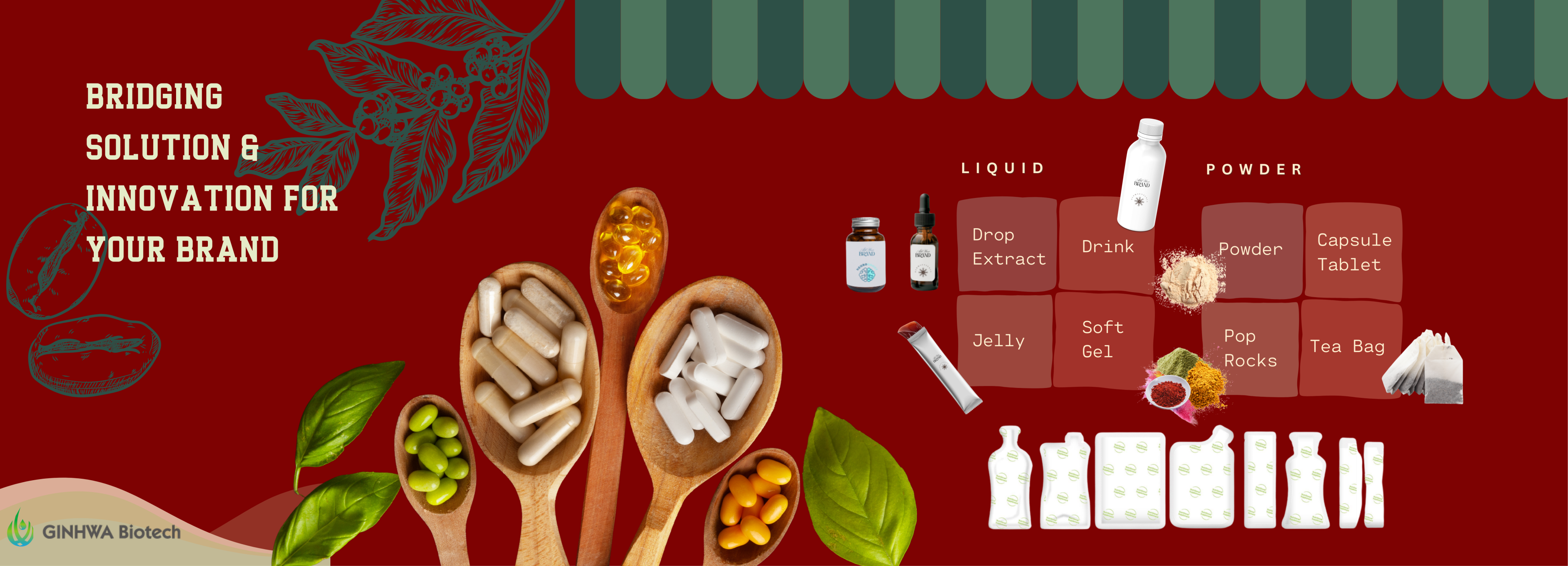

Tea Bag
We offer development for herbal blends, extract powders, and functional tea formulas, supporting triangle tea bags, flat tea bags, and single-pack tea bag filling. All processes follow international food safety standards, enabling brands—especially e-commerce and retail channels—to launch products quickly.
Which Products Are Suitable for Tea Bag OEM?
Tea Bags are suitable for herbal teas, functional beverages, daily wellness teas, and health formulas. They can be combined with botanical powders, extract powders, or blended ingredients to adjust flavor, intensity, and overall product positioning.
The Tea Bag dosage form combines brewing convenience and formulation flexibility, supporting everything from small pilot batches and limited launches to large-scale production. It is especially suitable for e-commerce brands, channel brands, and health drink companies looking to quickly expand their tea offerings.
Tea Bag Types and Packaging Specifications
Gin Hwa offers multiple Tea Bag production formats. You can select the most suitable form based on ingredient characteristics, desired flavor profile, and channel requirements:
- Triangular Tea Bags (approx. 1.5–3 g fill weight; ideal for herbal pieces, fruit chunks, or highly aromatic blended teas)
- Flat Tea Bags (suitable for crushed ingredients, fine granules, or formulas enhanced with extract powders)
- Individually Wrapped Tea Bags (can be paired with foil pouches, nitrogen flushing, and customized printed packaging)
Packaging specifications, minimum order quantity, and packaging customization details will vary depending on formula complexity. For detailed specifications, please contact us
Ingredients and Forms Suitable for Tea Bags
The Tea Bag dosage form accommodates diverse ingredient types and is suitable for developing a wide range of health and flavored tea beverages:
- Herbal Ingredients: chamomile, rose, mint, lemongrass
- Fruit Pieces: apple pieces, dried berries, citrus peel
- Grain-Based Ingredients: red beans, barley, black beans, cassia seeds
- Extract Powders: herbal extracts and botanical functional powders (with grind size adjusted as needed)
- Blended Powder Mixes: formulas combining 2–6 or more ingredients
Powders must be ground and sized according to the sealing method to ensure uniform particle size and prevent powder leakage or incomplete sealing.
Tea Bag Dedicated Process Management and Three-Tier Quality Assurance
1) Tier One: Tea Bag Ingredients and Process Control
From raw material receiving to finished product shipment, standardized testing and defined process checkpoints ensure each batch of Tea Bags is consistent in quality and fully traceable.
Raw Material Identity Verification
Verify ingredient origin, specifications, and documentation integrity, and inspect incoming materials against established standards.
Particle Size and Sieving Tests
Adjust grind size and sieving conditions according to the formula and Tea Bag structure to maintain powder flowability and brewing experience.
Blend Uniformity and Moisture Testing
Check distribution of key ingredients and moisture content to ensure a homogeneous formula that remains stable and free from caking.
Production of Three Tea Bag Formats
Triangular Tea Bags, flat Tea Bags, and individually wrapped Tea Bags can be flexibly planned based on channel and product positioning.
Ultrasonic / Heat Seal Integrity Check
Set sealing parameters according to different packaging materials and machines, checking seal strength and tightness to prevent powder leakage.
Packaging Structure, Labeling, and Lot Management
Select packaging structures based on storage requirements, and establish labeling and lot management systems to support downstream traceability and control.
Finished Product Inspection and Retention Samples
Complete checks on appearance, weight, seal integrity, and basic physicochemical items, while retaining samples to build batch records.
Project-Based Production Scheduling and Shipment Management
Schedule production by project batches, manage process timelines and shipping milestones, and reduce the risk of stock-outs across channels.
2) Tier Two: International-Grade Quality Standards
Gin Hwa’s Tea Bag production process complies with multiple food safety and factory management standards, covering food safety systems, hazard analysis, international food plant management, and multi-country market access requirements. These certifications enable us to support OEM / ODM projects for everyday teas, functional wellness teas, local brands, and global private-label partners.
3) Tier Three: External Audits and Government Inspections
The facility is regularly audited and randomly inspected by regulatory authorities. In case of any nonconformity, CAPA procedures, lot traceability, and product recall processes are activated in line with regulations. More core technologies and service workflows
Tea Bag FAQ
Q1|What is the minimum order quantity (MOQ) for Tea Bags?
MOQ varies depending on Tea Bag type, packaging requirements, and formula complexity. In general, triangular Tea Bags and flat Tea Bags offer higher flexibility, supporting small batches for market testing or scaled mass production based on channel needs.
Q2|What Tea Bag packaging materials are available?
Common materials include PET, nylon, and corn fiber (PLA). Different material structures can be selected based on product positioning, channel requirements, and the expected shelf life, with varying breathability and heat resistance.
Q3|Can Tea Bags be individually wrapped and nitrogen flushed?
Yes. Gin Hwa can provide individually wrapped Tea Bag formats with packaging structures such as aluminum foil pouches, matte pouches, and glossy film pouches. Nitrogen flushing is also available to help maintain aroma stability and extend shelf life.
Q4|How long does Tea Bag product development usually take?
Timelines vary depending on formula complexity and the level of packaging customization. A typical process includes “formula confirmation → sampling → packaging confirmation → trial production → mass production,” with a common development cycle of about 4–8 weeks.
Q5|If we already have a formula, can we directly outsource Tea Bag manufacturing?
Yes. If you already have a formula, raw materials, or a reference sample, Gin Hwa can help adjust the grind size and particle distribution to suit Tea Bag production, and provide optimization recommendations for blending, sealing, and flavor stability.